
Rule-based mode (Variant 2)
In this mode, messages are analyzed by server-side rules and eventually moved into Cryptshare.nsf for further processing.
Server-side mail rules
-
Manage mail rules in the Domino Directory in the section Configurations > Servers > Configurations
-
Edit the server configuration document and select the tab Router/SMTP > Restrictions and Controls > Rules Here you can create new rules or edit, delete or disable existing rules.
If you use a product from a third-party vendor to manage mail traffic rules, you can create rules in the same sense as described below using the product of the third-party vendor to configure the rule-based operation of Cryptshare for Notes. Please note the manufacturer’s instructions.
A server-side rule for email messages might look as follows:
-
If the number of attachments is larger than 0,
-
and the total message size exceeds 10.000.000 Bytes (approx. 10 Mbyte)
-
and the form name equals "Memo"
-
and the sender contains your organization name (e.g. "/befineDev")
-
and the subject does not contain the placeholder [CS4N_Internal]
-
then the message will be moved into Cryptshare.nsf.
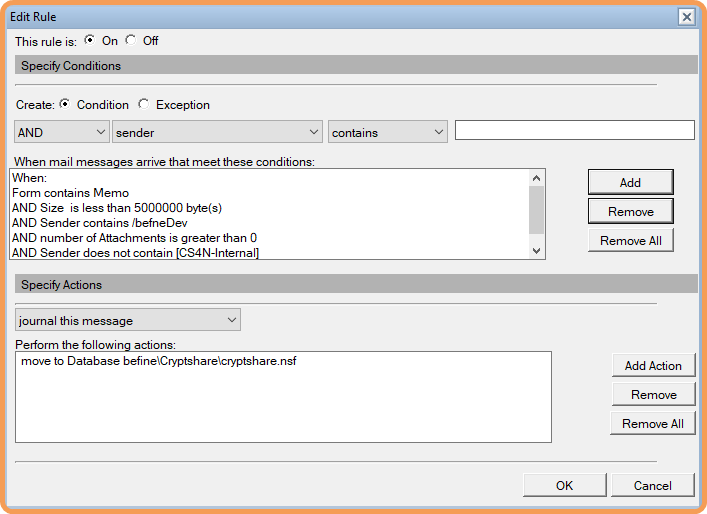
CS4N (Cryptshare for Notes) scans Cryptshare.nsf on a regular basis for new messages to process.
Setting up rules in the Domino Directory
-
Make sure to include the forms "Memo", "Reply" and "Forward" into you rule to cover all types of messages that can be sent from a Notes Client.
-
New rules will only become active when the server reloads the email rules from the Domino Directory. Reloading takes place every 5 minutes when the server task checks the configuration documents. Use the following command on the Domino Server console to trigger reloading of rules manually: set rules
-
Check the policies for senders/recipients allowed to use the Cryptshare Server. The policies for the Cryptshare Server must grant permissions to exchange files to the same group of users as specified in CS4N.
Advantages
-
A central set of rules can be defined which is mandatory for all specified users of the system.
-
The user doesn’t need to take or consider taking any action.
-
No software roll-out is required on thecClient side.
-
The users will just need some basic instruction. They need to understand the auto-generated message that Cryptshare sends back to the sender.
-
The router/mail.box will not have to handle large emails.
-
To distribute the traffic load in a system with several mailboxes, a number of CS4LN installations can be used.
-
Messages of any size can be delivered regardless of restrictions for the mailbox size or the message size that may exist on the sender’s side.
Important information
-
With large email traffic, the CS4N application (Cryptshare.nsf) may take up a significant amount of storage space.
-
Lotus Domino’s "compact" task should be run against CS4N daily.
-
The emails processed by Cryptshare bypass the standard mail route and may have to be monitored separately.